The Sites That Actually Influence AI Answers in Your Industry

Executive SummaryAI answer engines do not discover brands by crawling random websites. They pull from a concentrated set of trusted publishers, directories, review platforms, and community forums that have already earned a place in their retrieval corpus.Every industry has its own set of "kingmaker domains": 15 to 25 sites that disproportionately shape which brands get recommended. Getting mentioned on these sites matters far more than optimising your own pages.Across 58.6 million citations analysed between October 2025 and March 2026, the top-cited domains vary sharply by industry: G2 and Reddit dominate SaaS, NerdWallet and Bankrate dominate fintech, Mayo Clinic and NIH dominate medical. The list is short. The stakes are high.Opal, an ad spend management platform for marketing agencies, went from 0% AI visibility to 15.9% and 1,766 brand mentions in 31 days. Not by rewriting their homepage, but by building a citation footprint across the right third-party sources.
Most AEO advice tells you to optimize your website. Rewrite your headings. Add FAQ schema. Make your content more conversational.
That advice is not wrong. But it is incomplete, and for most brands, it is the wrong place to start.
Here is what the data actually shows: AI answer engines do not build their responses by crawling every website on the internet and ranking the best one. They pull from a pre-selected corpus of trusted sources. A relatively small number of publishers, directories, review sites, and community platforms that the models have learned to trust over time.
The uncomfortable truth: your website is not in that corpus by default. Getting it there requires more than better content. It requires presence on the sites that are already inside the retrieval set.
This article maps those sites by industry. More importantly, it explains why they exist, how to identify them in any niche, and what it actually means for your AEO strategy.
How AI Answer Engines Actually Build Their Retrieval Sets
AI engines do not retrieve information the way a search engine ranks pages. The mechanics are different, and understanding them changes everything about how you approach visibility.
When you ask ChatGPT a question, it does not scan the entire web and return the best result. It decomposes your query into sub-queries, sends those to Bing's index, retrieves and chunks the top-ranking pages, then selects the most relevant passages from that pool. Domain authority carries roughly 40% of the weight in source selection, content quality another 35%, and platform trust signals the remaining 25%, according to citation analysis by ZipTie.dev (2025).
Perplexity operates differently. Every query triggers a live retrieval-augmented generation (RAG) search against a proprietary index of over 200 billion URLs. It scores sources on four factors: semantic clarity, content freshness, structural parse-ability, and entity authority. Perplexity pulls up to 40% more citations from trusted, high-authority websites compared to mid-tier blogs (CapConvert, 2026).
Google AI Overviews pull from Google's own search index and E-E-A-T signals. Gemini trusts structured first-party data. The platforms diverge on which sources they prefer — Only 11% of domains are cited by both ChatGPT and Perplexity, according to a Digital Bloom analysis of 680 million citations.
What this means in practice
The practical consequence is straightforward. Each AI engine has already formed a view of which sources are trustworthy in your category. Those sources form the retrieval set. Brands that appear in those sources get cited. Brands that do not, do not.
This is not a ranking problem. It is a presence problem.
The core principle: AI systems trust consensus across authoritative sources more than self-published website structure. A well-optimised page on a domain the model has never encountered is worth less than a single mention on a domain it already trusts.
The brands winning in AI search right now are not winning because they have better content on their own sites. They are winning because they have built a presence on the sites that are already inside the retrieval set for their category.
What "Kingmaker Domains" Are
A kingmaker domain is any site that AI engines consistently pull from when answering queries in a specific industry or category. The term is useful because it captures what these sites actually do: they determine which brands get recommended and which do not.
Kingmaker domains share a common set of characteristics:
- High citation frequency: across multiple AI platforms, not just one
- Editorial independence: they are not owned by the brands they cover
- Category depth: they have published extensively on a specific topic or vertical for years
- Structural quality: their content is machine-extractable: clear headings, visible dates, author bylines, factual density
- Distribution footprint: their content gets syndicated, referenced, and linked to by other authority sites
The data from Goodie AI's analysis of 58.6 million citations (October 2025 to March 2026) illustrates the concentration clearly. Wikipedia leads at 3.4% citation share. YouTube at 2.1%. Reddit at 1.4%. But here is the critical finding: industry rankings diverge sharply from the overall list. TechRadar commands 8.86% citation share in B2B SaaS CRM. NerdWallet is the clear leader in retail banking and personal finance. The generic list tells you very little about what actually matters in your specific vertical.
Why authority concentration has increased
As AI models have matured, their source selection has become more concentrated, not less. Publishers built for breaking news have lost citation share. Platforms and review sites built for decision-making have gained it.
The reason is structural. AI engines are optimised to answer questions, not to surface the latest news. A site that has spent five years publishing in-depth comparisons of project management software is more useful to an LLM answering "what is the best project management tool for agencies" than a news site that covered the same topic once.
SE Ranking's analysis of 129,000 unique domains found that domains listed on multiple review platforms earned 4.6 to 6.3 citations on average, versus 1.8 for brands absent from those platforms. That is a 3x citation multiplier from directory presence alone.
This is why the kingmaker concept matters. These sites are not just high-traffic destinations. They are the infrastructure through which AI engines validate brand authority.
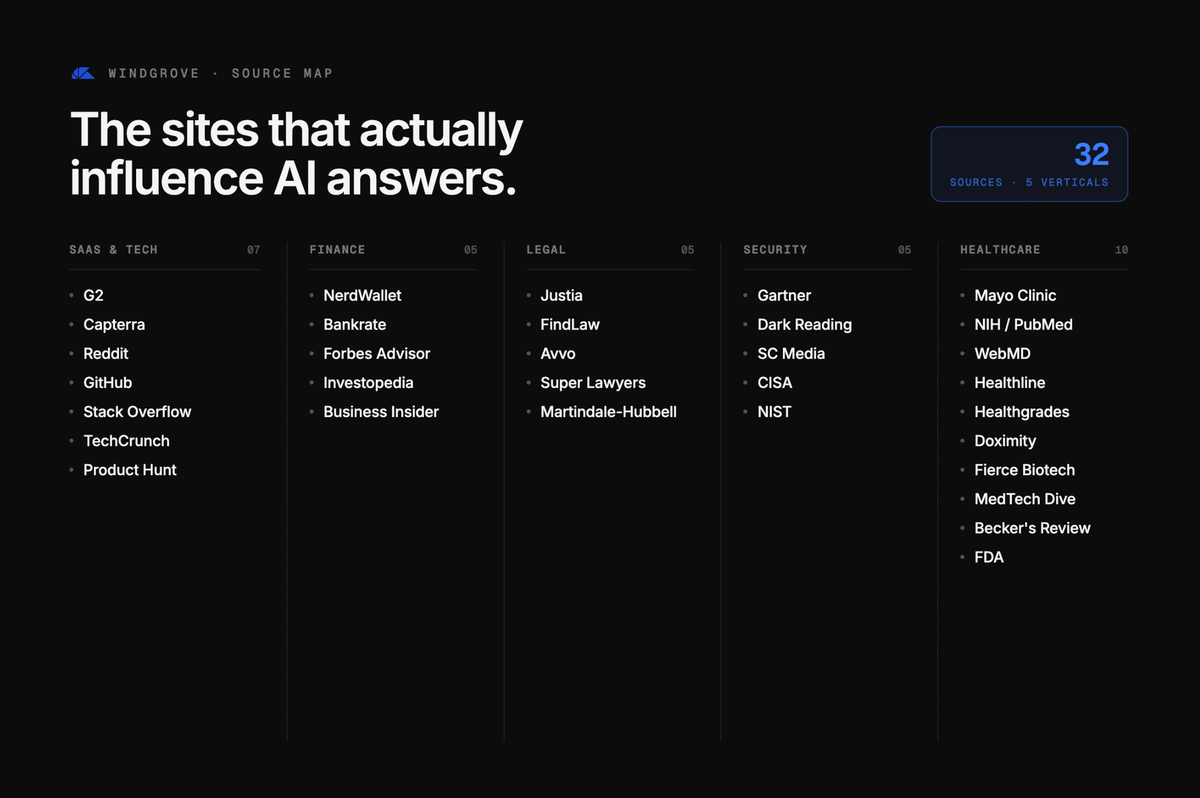
The Kingmaker Domains by Industry
The following breakdown is drawn from citation analysis across ChatGPT, Perplexity, Google AI Overviews, and Gemini. These are not the only sources AI engines pull from in each category. They are the ones that appear with the highest frequency across multiple platforms, meaning a presence on these sites gives you the broadest citation coverage for the least effort.
B2B SaaS
The SaaS category is dominated by structured review platforms and developer communities. AI engines treat peer-validated review data as a strong trust signal because it represents aggregated third-party opinion rather than brand-controlled content.
Domain | Why It Matters |
|---|---|
G2 | Highest citation frequency for SaaS across all major LLMs; structured reviews with verified buyer data |
Capterra | Gartner-owned; high editorial authority; consistently cited in "best software for X" responses |
r/entrepreneur, r/SaaS, r/startups pull heavily; real user language matches conversational queries | |
GitHub | Critical for dev tools; AI engines treat GitHub presence as an entity validation signal |
Stack Overflow | Developer-facing SaaS; cited for technical questions and tool comparisons |
TechCrunch | Funding and launch coverage; high domain authority; cited for company background and credibility |
Product Hunt | Launch visibility; cited in "new tools" and "alternatives to X" queries |
The SaaS insight: G2 and Capterra together account for a disproportionate share of AI citations in software categories. A brand with zero reviews on either platform is invisible in the most commercially valuable queries.
Fintech and Financial Services
Fintech is tightly regulated and high-trust, which means AI engines default to established financial media and comparison platforms rather than brand-controlled content. Getting cited here requires presence on the sites that have already earned editorial trust.
Domain | Why It Matters |
|---|---|
NerdWallet | Dominant citation source for personal finance and payments; AI engines treat it as a primary reference |
Bankrate | Consistently cited for interest rates, financial products, and fee comparisons |
Forbes Advisor | High citation rate for "best X" fintech queries; editorial review format maps well to AI retrieval |
Investopedia | Cited for definitions, comparisons, and educational finance content |
Business Insider | Fintech news and product coverage; cited for company and product credibility |
The fintech insight: NerdWallet alone accounts for a significant share of citations in the personal finance and payments category. If your product touches consumer finance and you are not in a NerdWallet roundup, you are likely invisible to the most common buyer queries.
Legal and Professional Services
Law is a category where AI engines are cautious. They default heavily to established legal directories and institutional sources because the stakes of a wrong recommendation are high.
Domain | Why It Matters |
|---|---|
Justia | Free legal information; cited extensively for legal definitions and firm lookups |
FindLaw | One of the most cited legal resources across all LLMs |
Avvo | Attorney directory with peer ratings; cited for "best lawyer in X" queries |
Super Lawyers | Peer-nominated directory; high editorial credibility in legal AI responses |
Martindale-Hubbell | Oldest legal directory; AI engines treat long-standing directories as authority signals |
The legal insight: Law firm websites almost never get cited directly. The citation chain goes through directories. A firm without profiles on at least three of these platforms is effectively invisible in AI-generated legal recommendations.
Cybersecurity
Cybersecurity is a technical category where AI engines weight vendor-neutral analysis and research heavily. Brand-controlled content is treated with more scepticism here than in almost any other vertical.
Domain | Why It Matters |
|---|---|
Gartner | Magic Quadrant placements are cited extensively; highest authority signal in enterprise security |
Dark Reading | Editorial news and analysis; cited for threat intelligence and product context |
SC Media | Industry publication; cited for product reviews and security news |
CISA (.gov) | Government authority; cited for compliance and threat advisories |
NIST (.gov) | Framework and standards citations; high trust for technical security queries |
The cybersecurity insight: Government domains (.gov) carry outsized authority in security queries. A presence in CISA advisories or NIST framework documentation is worth more than most commercial placements.
Medical and Healthcare
Healthcare is the most authority-concentrated category in AI citations. AI engines are extremely conservative here, defaulting almost entirely to institutional medical sources. The window for brand-level citation is narrower, but it exists in the comparison and service-finder layer.
Domain | Why It Matters |
|---|---|
Mayo Clinic | Highest citation frequency in medical queries across all LLMs |
NIH / PubMed | Government research authority; cited for clinical evidence and treatment options |
WebMD | Consumer-facing health information; cited for symptom and condition queries |
Healthline | Editorially reviewed health content; cited for wellness and treatment questions |
Healthgrades | Provider directory; cited for "best doctor in X" and practice-level queries |
Doximity | Physician verification; cited for professional credentials and speciality queries |
The healthcare insight: For clinical queries, the citation chain almost never reaches a brand's own website. But for service-finder queries ("best concierge doctor in NYC"), directories like Healthgrades and Doximity are the primary citation layer. That is where brand visibility is won or lost.
Medtech and Life Sciences
Domain | Why It Matters |
|---|---|
Fierce Biotech | Industry news; cited for product launches and clinical trial coverage |
MedTech Dive | Regulatory and product news; high citation rate for device and diagnostics queries |
Becker's Hospital Review | Healthcare operations and strategy; cited for market context |
FDA (.gov) | Regulatory authority; cited for device approvals and compliance queries |
How to Identify Kingmaker Domains in Any Niche
The lists above cover the most common verticals. But every niche has its own citation hierarchy. Here is a repeatable process for mapping it in any category.
Step 1: Run the queries your buyers are running. Open ChatGPT, Perplexity, and Google AI Overviews. Ask the same question in all three: "what is the best [your category] for [your ICP]." Note every source cited in the response. Do this for 10 to 15 queries. Patterns will emerge quickly.
Step 2: Map the overlap. The domains that appear across multiple AI platforms for multiple queries are your kingmaker domains. A site cited by only one platform for one query is a secondary signal. A site cited by all three platforms across five different queries is a primary target.
Step 3: Assess your current presence. For each kingmaker domain you identify, check whether your brand has a listing, a review, a mention, or any form of presence. This gap analysis tells you exactly where to focus.
Step 4: Prioritise by citation frequency and acquisition difficulty. Some kingmaker domains (G2, Capterra, Crunchbase) are accessible to any brand that creates an account. Others (Forbes Advisor, Gartner) require editorial relationships or research participation. Start with the accessible ones and build toward the harder placements.
The core principle: You do not need to be on every site. You need to be on the right 10 to 15 sites for your specific category, consistently and with enough depth that AI engines can extract and cite your brand with confidence.
What This Looks Like in Practice: The Opal Case Study
Opal is a charge card and spend management platform built for digital marketing agencies. When Windgrove began working with Opal, the brand had zero AI visibility across ChatGPT, Perplexity, and Google AI Overviews. Their website was well-built. Their product was strong. But they had no presence on the kingmaker domains in their category.
The intervention was not a website rewrite. It was a citation graph build.
Over 31 days, Windgrove secured placements and structured mentions across the third-party sources that AI engines consistently cite for fintech and spend management queries. The results, tracked via Searchable:
AI Visibility Score: 0% to 15.9% in 31 days
Brand mentions across LLMs: 1,766 tracked mentions
Primary driver: Third-party citation footprint, not on-site content changes
This is what citation graph management looks like in practice. The homepage did not change. The product did not change. What changed was where Opal existed on the web — and which of those places AI engines already trusted.
Read the full Opal case study or see more results on our proof page.
The Strategic Shift: From Website Optimisation to Citation Graph Management
Most AEO advice is built around a false assumption: that AI engines discover brands the same way Google does, by crawling and ranking individual pages.
They do not.
AI engines form a view of the world from their training data and retrieval corpus. That corpus is dominated by the kingmaker domains in each category. A brand that is absent from those domains is not ranked lower. It is simply not in the conversation.
The strategic implication is significant. The question is not "how do I make my website more AI-friendly?" The question is "which sites does the AI already trust in my category, and how do I get mentioned there?"
The shift in practice looks like this:
Stop: Publishing more blog posts optimised for Google keywords
Start: Identifying the 10 to 15 kingmaker domains in your category and building a presence on each
Stop: Treating your homepage as your primary AI citation asset
Start: Treating G2, Reddit, NerdWallet, Healthgrades (or their equivalent in your vertical) as your primary citation infrastructure
Stop: Measuring success by organic traffic
Start: Measuring AI visibility score and share of voice across tracked prompts
This is not a rejection of on-site content. Technical infrastructure, FAQ schema, and structured content still matter. But they are the floor, not the ceiling. The ceiling is determined by your citation graph.
Want to Know Which Kingmaker Domains Matter for Your Category?
Identifying the right sites, getting listed on them, and building the citation footprint that moves your AI visibility score is exactly what Windgrove does. Fully managed, with results tracked in Searchable from day one.
Book a free discovery call and we will map the kingmaker domains in your category and show you exactly where your brand is missing from the AI retrieval set.
Frequently Asked Questions
What are kingmaker domains in AI search?
Kingmaker domains are the publishers, directories, review platforms, and community sites that AI engines repeatedly cite when answering industry questions. They matter because AI systems use source trust, repeated mentions, and consensus across independent sites to decide which brands to recommend. A brand present on these sites is far more likely to appear in AI-generated answers than a brand that only exists on its own website.
Why does my website alone not get cited by AI engines?
A website can be well-written and technically sound and still be ignored by AI engines if it lacks third-party validation. AI engines tend to trust consensus from external sources more than self-published pages, especially in commercial categories where reputation, reviews, and editorial coverage influence confidence. Your website signals what you say about yourself. Kingmaker domains signal what others say about you. AI engines weight the latter more heavily.
Which industries rely most on kingmaker domains?
B2B SaaS, fintech, legal, cybersecurity, healthcare, and medtech all show strong concentration around a small set of recurring sources. In each category, a handful of domains account for a disproportionate share of AI citations, particularly in comparison and recommendation queries. Healthcare is the most concentrated, with Mayo Clinic, NIH, and WebMD dominating clinical queries. SaaS is dominated by G2, Capterra, and Reddit.
How do I find the kingmaker domains in my niche?
Run the same buyer questions in ChatGPT, Perplexity, and Google AI Overviews, then record the domains cited most often across multiple queries. Aim for 10 to 15 different queries that reflect how your buyers actually search. The domains that appear across multiple platforms and multiple queries are your kingmakers. The overlap between platforms is the highest-priority target list.
What is the fastest way to get mentioned in AI answers?
The fastest path is not more on-site content. It is getting listed, reviewed, or mentioned on the domains that already sit inside the retrieval sets for your category. For SaaS, that means G2 and Capterra. For fintech, NerdWallet and Forbes Advisor. For healthcare, Healthgrades and Doximity. Once those placements are in place, supporting them with structured, citation-friendly content on your own site compounds the effect over time.