Is AEO Actually Working, or Is It Just SEO with a New Name?

Executive SummaryAI answer engines (ChatGPT, Perplexity, Google AI Overviews) now handle over 35% of all search queries, a 120% increase from 2023 levels, and they pull from entirely different signals than traditional search.AEO is not SEO with a new coat of paint. It requires a distinct technical foundation, different content structure, and a third-party citation footprint that Google rankings do not provide.The data is clear: brands implementing AEO alongside SEO report up to 43% increases in brand visibility and 37% more qualified leads compared to SEO-only approaches.Windgrove has delivered measurable AI visibility results for clients in fintech, professional services, and SaaS, taking one client from 0% AI visibility to a #1 average LLM position in 31 days.
Every few years, a new acronym lands in the marketing world and the skeptics ask the same question: is this real, or is it just the last thing repackaged?
AEO is getting that question right now. Answer Engine Optimization. Optimize for AI. Get cited by ChatGPT. Show up in Perplexity. It sounds, to a reasonable person, like SEO with a rebrand and a fresh coat of hype.
The skepticism is understandable. But it is wrong.
AEO is not a renaming exercise. The mechanics are genuinely different, the signals are different, and the results, when the work is done properly, are measurable and distinct from anything SEO alone produces. This article makes that case with data, explains exactly where the two disciplines diverge, and shows what AEO looks like when it works in practice.
The core question: Does optimizing for AI answer engines produce outcomes that SEO cannot? The answer is yes. Here is why.
The Fundamental Difference: Ranking vs. Synthesizing
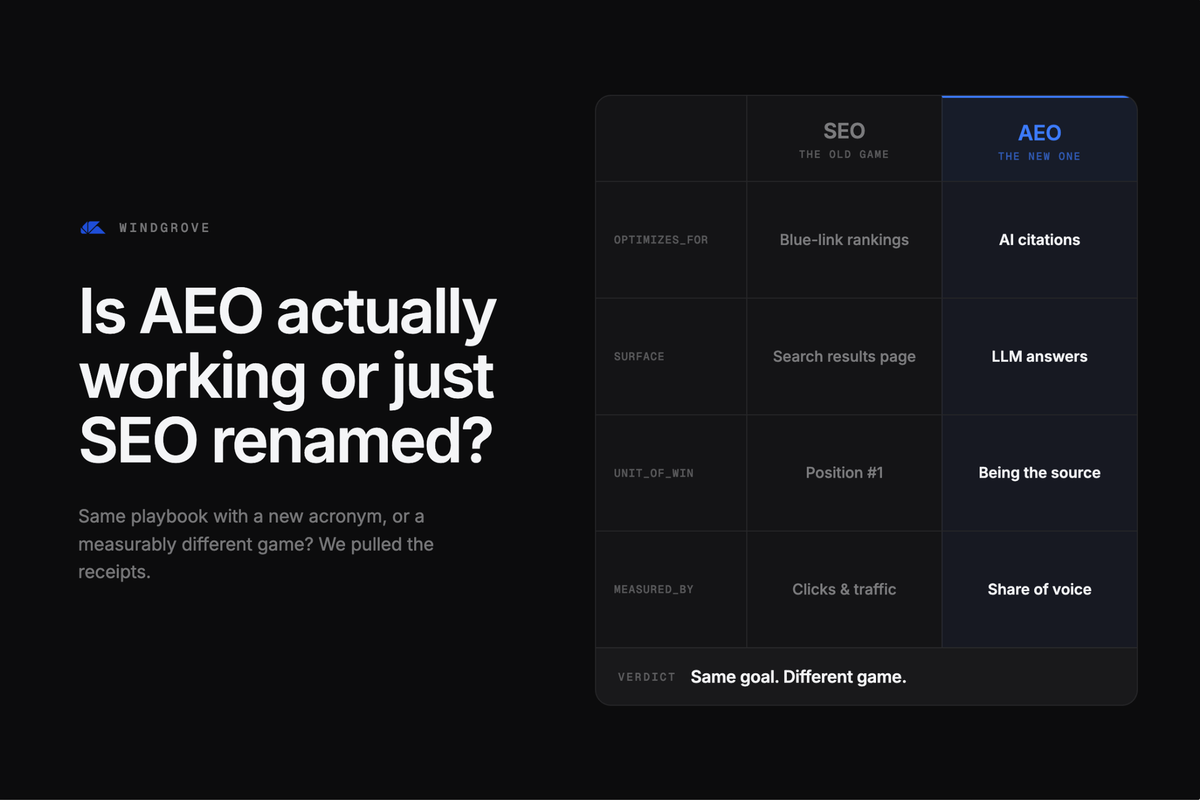
Google ranks pages. AI engines synthesize answers.
That single sentence captures the entire distinction. When someone types "best spend management tool for agencies" into Google, they receive a list of links and decide where to click. When they ask the same question to ChatGPT or Perplexity, they receive a personalized, conversational recommendation, often with specific vendor names, reasons why, and comparisons, all generated from the AI's internal understanding of the market.
The buyer never visits ten websites. They read one answer and often act on it.
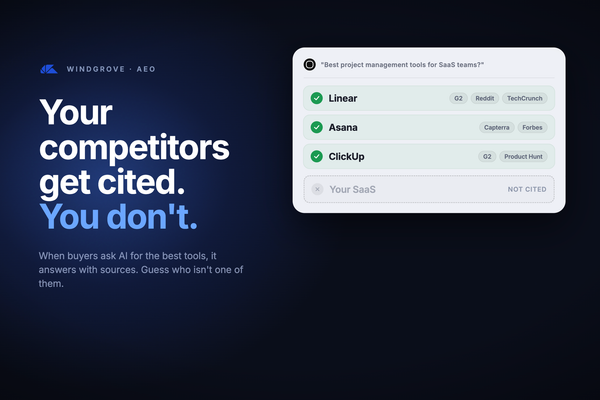
The uncomfortable truth: AI engines do not rank your page. They synthesise an answer and name the brands they consider authoritative. If your brand is not in that answer, you are invisible to a buyer who has already made up their mind before they visit a single website.
This is not a subtle distinction. It changes the entire logic of how you earn visibility.
What Google rewards vs. what AI engines reward
Signal | Traditional SEO | AEO |
|---|---|---|
Primary ranking factor | Backlinks + keyword relevance | Entity authority + citation footprint |
Content structure | Keyword density, headings, meta | Direct answer in first 40-60 words |
Technical requirements | Crawlability, page speed, Core Web Vitals | Schema markup, llms.txt, canonical clarity |
Third-party validation | Backlinks from authority domains | Mentions on Reddit, directories, publications |
Measurement | Rankings, organic traffic | AI visibility score, share of voice, LLM citations |
A page can rank on page one of Google and be completely invisible inside an AI-generated answer. The reverse is also true: a well-structured page with strong entity signals and a solid citation footprint can appear in AI responses without ranking anywhere near the top of traditional search.
According to HubSpot's 2026 Consumer Trends Report, the average prompt length in ChatGPT is 23 words, compared to 3.37 words in traditional search. That is not a user typing a keyword. That is a user having a conversation. And the AI engine pulling from your content needs to understand your brand as an entity, not just a collection of keyword-optimized pages.
That is the structural difference. And it is why SEO work, done without AEO in mind, does not transfer.
The Data Behind AEO's Results
The skeptic's next move is to ask for proof. Fair enough. Here is what the research shows.
A meta-analysis of 27 AEO case studies published between 2024 and 2025 found weighted average improvements across the following metrics:
- AI citation frequency: +213%
- Voice search visibility: +167%
- Conversion rate from AI referrals: +28%
- Brand mention sentiment: +42%
These are not small movements. A 213% increase in how often an AI engine cites your brand is the difference between being invisible and being the default recommendation.
HubSpot's own internal data is equally direct. Their marketing team reported 3x better lead conversion from AEO-sourced traffic compared to other acquisition channels. The reason is structural: AI engines personalize answers based on what they know about the user's context, so the traffic that arrives from an AI citation is pre-qualified in a way that a Google click rarely is.
The zero-click reality: According to BrightEdge's March 2025 research, over 60% of search queries now generate AI-powered answers that reduce direct website clicks. Google's AI Overviews alone answer more than 50% of queries without requiring a click. A Bain and Company analysis puts the economic stakes plainly: zero-click search behaviour could impact $750 billion in revenue by 2028.
That is not a trend to monitor. That is a shift to act on.
Why the "it's just SEO" argument falls apart
The strongest version of the skeptic's argument goes like this: AEO is just good SEO. Write quality content, earn authority, get cited. Nothing new.
There is some truth here. Good content remains foundational. But the argument collapses on three specific points:
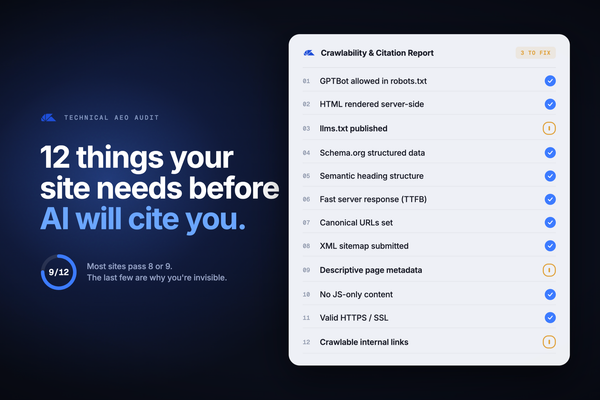
- Technical infrastructure is different. SEO does not require an llms.txt file, FAQ schema on every applicable page, or canonical URL resolution tuned for LLM crawlers. These are AEO-specific interventions. A technically sound SEO site can still be completely unreadable by AI engines.
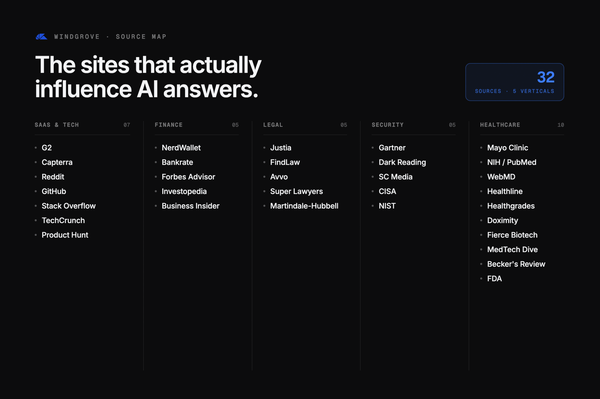
- Citation footprint is different. AI engines require third-party validation from sources they trust: Reddit threads, directory listings, publications. A company with strong backlinks but no Reddit presence and no directory listings will not be confidently cited by an LLM, regardless of its domain authority.
- Content structure is different. Google rewards comprehensive, well-linked content. AI engines reward content that delivers a direct answer in the first 40-60 words. Content structured for Google often buries the answer. That content does not get cited. Research confirms that answer engines demonstrate a measurable 2.7x preference for content that directly addresses user questions in the opening text.
Three distinct requirements. None of them is SEO.
What AEO Actually Looks Like in Practice: The Opal Case
Theory is useful. Numbers from a real engagement are more useful.
In late March 2026, Opal, a charge card and spend management platform built for digital marketing agencies, had a strong product and zero AI search visibility. Their site had four indexed pages, no blog, no sitemap submitted to Google Search Console, and a 0% AI visibility score across ChatGPT, Perplexity, and Google AI Overviews. Buyers searching for their category were finding only competitors.
The full Opal case study is documented here. The summary is this: in 31 days, the numbers moved from zero to the following.
- AI Visibility Score: 0% to 15.9%
- AI Brand Mentions: 0 to 1,766
- Average LLM Position: #1
- Site Health Score: 66.2 to 80.7 (top 10% of benchmarked sites)
- AEO Articles Published: 8
How the results were produced
The work followed a deliberate sequence. Technical foundation first. Content second.
Before a single article was written, every blocker between Opal's pages and AI crawlers was cleared. The XML sitemap was submitted. The robots.txt was rewritten. An llms.txt file was built from scratch. Meta titles and descriptions were rewritten across every core page. Heading hierarchy and internal linking were restructured. Indexing issues on key products and landing pages were resolved.
Only once the foundation was solid did content production begin. Every article was mapped to a specific buyer query, filtered through three criteria: search volume, buyer intent, and competitive opportunity. The result was eight published articles and a set of bottom-of-funnel pages, all structured so AI engines could read, understand, and cite them.
Within one week of launching the Ad Pay page, Opal ranked #2 for "ad pay" and #2 for "ad spend cards." These are not informational terms. Businesses searching for those phrases are in the market and ready to move.
The compounding effect: The 15.9% AI visibility score reached in 31 days is not a ceiling. It is a starting point. Each article published from a clean technical foundation adds a new surface for AI engines to cite. The 1,766 brand mentions accumulated in month one were earned, not paid. Zero ad spend. Pure citation.
This is what AEO produces that SEO alone cannot. Not just traffic. Authoritative presence inside the conversations buyers are already having.
You can see more results like this on the Windgrove proof page.
The Five Levers That Separate AEO from SEO
If AEO were just SEO, you could apply the same playbook and expect the same results. You cannot. The levers are different.
Here are the five interventions that move AI visibility scores and have no direct equivalent in traditional SEO:
1. Answer-first content structure
AI engines look for a direct answer in the first 40 to 60 words of a page. If your content spends the opening paragraphs building context before delivering the answer, it will not be cited. The structure that wins in SEO, comprehensive, well-linked, thorough, is often the structure that loses in AEO.
Every piece of AEO content needs to pass a simple test: if an AI engine read only the first 100 words of this page, would it have a complete, citable answer to the target query? If the answer is no, the content needs to be restructured.
2. Schema markup at scale
Websites with comprehensive schema markup implementation are 78% more likely to be referenced by AI systems compared to those without structured data. FAQ schema is particularly high-leverage: it allows AI engines to pull individual question-and-answer pairs as standalone citations, independent of the full page.
Most SEO implementations include basic schema. AEO requires FAQ schema on every applicable page, Article schema with author attribution and publication date, and Organization schema that connects all content back to a verified entity.
3. Entity consistency across the web
AI engines cross-reference a brand's presence across multiple sources before deciding whether to cite it confidently. If your LinkedIn company description says one thing, your Crunchbase listing says another, and your website says a third, the LLM's confidence in recommending you drops.
Entity consistency, aligning how your brand is described across every directory, profile, and publication, is an AEO-specific discipline. It has no meaningful SEO equivalent.
4. Third-party citation footprint
A company that exists only on its own website will not be confidently recommended by an AI engine. LLMs require external validation: Reddit threads, directory listings, press mentions, and reviews. These sources function as the AI equivalent of backlinks, but they operate differently. A single well-placed Reddit thread, properly structured and upvoted, can generate LLM citations for months.
5. Funnel-stage content coverage
Most companies have some top-of-funnel content and almost nothing at the bottom. Someone asking ChatGPT "how do I sign up for [your product]" or "what is the onboarding process for [your service]" will get no answer if you have not written content that tells AI engines what the next step is.
BOFU visibility is where AEO converts. It is also where the vast majority of companies have a 0% AI visibility score.
These five levers compound. A clean technical foundation amplifies every piece of content published on top of it. Content published on a broken foundation, without schema, without entity consistency, without a citation footprint, sits there and does not move the needle.
You can read more about the full AEO approach on the Windgrove blog.
The Honest Answer: AEO and SEO Are Not Enemies
Here is where the nuance matters.
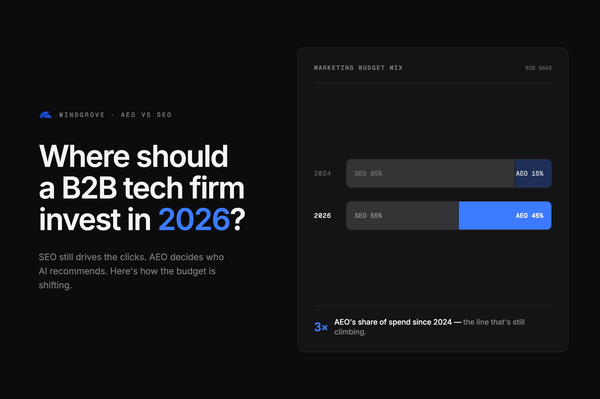
AEO is not a replacement for SEO. Organic search still drives 25 to 42% of website traffic across major industries, according to Conductor's AEO/GEO Benchmarks Report, which analyzed 13,770 domains and 3.3 billion sessions. Traditional search is not dead. It is being compressed.
The question is not "should I do AEO or SEO?" The question is, "Am I building a presence that works across both engines?"
Strong SEO performance and strong AEO performance are correlated. A site with clean technical infrastructure, authoritative content, and a credible external presence will perform better in both channels. The work is not redundant. But it is also not identical.
The practical reality: Most companies have invested years in SEO and have almost nothing purpose-built for AI citation. That asymmetry is the gap. The companies closing it now are capturing category authority in AI search before their competitors realise the opportunity exists.
Where to start if you are behind
If you are unsure where your AI visibility stands right now, the starting point is an audit. Not a content audit. An AI visibility audit: which prompts your buyers are using, which AI engines are answering them, which brands are being cited, and whether you are one of them.
That audit tells you two things. First, how large the gap is. Second, which interventions will close it fastest.
For most companies, the gap is larger than expected. A brand that ranks on page one of Google for its core category terms often has a 0% AI visibility score on the same terms. The work done for Google does not transfer automatically. It has to be rebuilt for a different engine.
The good news: the window is still open. AI visibility in most B2B categories is not yet dominant. The brands investing in AEO now are establishing positions that will be significantly harder to displace in 12 months than they are today.
Find Out Where You Stand
The first step is knowing your current AI visibility score. Not an estimate. Actual data: which prompts your buyers are using, which platforms are answering them, and whether your brand appears in those answers.
Windgrove offers a free AI visibility audit that maps your current position across ChatGPT, Perplexity, Google AI Overviews, and Gemini. You will see exactly where you are visible, where you are invisible, and which gaps represent the highest-leverage opportunities.
If you want to go further, you can book a free consultation with the Windgrove team. No generic deck. No obligation. A direct conversation about your specific situation and what a 30, 60, or 90-day AEO plan would look like for your business.
The question of whether AEO works has an answer. The more useful question is whether your brand is showing up in the answers your buyers are already getting.
Frequently Asked Questions
Is AEO the same as SEO? No. AEO and SEO share some foundations, including the importance of quality content and technical site health, but they target different engines with different signals. SEO optimizes for Google's ranking algorithm, which rewards backlinks, keyword relevance, and page authority. AEO optimizes for AI answer engines like ChatGPT, Perplexity, and Google AI Overviews, which require a direct answer in the first 40 to 60 words of content, comprehensive schema markup, entity consistency across the web, and a third-party citation footprint from sources like Reddit and industry directories. A page can rank on page one of Google and be completely invisible in AI-generated answers.
How long does AEO take to show results? Initial results, including improvements in featured snippet acquisition and early AI citations, can appear within two to four weeks of implementing structural changes. Meaningful movement in AI visibility scores typically occurs within one to three months. The Opal case study showed a 0% to 15.9% AI visibility score increase and 1,766 brand mentions in 31 days, achieved by fixing the technical foundation first and then publishing AEO-structured content.
Do I need to stop doing SEO to invest in AEO? No. AEO and SEO are complementary, not competing. Organic search still drives 25 to 42% of website traffic across major industries, and strong SEO performance often correlates with stronger AEO performance. The goal is a presence that works across both engines. Most companies are significantly under-invested in AEO relative to SEO, so the priority is closing that gap, not abandoning traditional search.
What metrics should I track for AEO? The primary metrics for AEO are AI visibility score (the percentage of tracked prompts where your brand is mentioned), share of voice across AI platforms, average LLM position, and funnel-stage visibility across TOFU, MOFU, and BOFU queries. Secondary metrics include brand mentions in AI-generated responses, LLM-attributed leads entering your funnel, and conversion rates from AI-sourced traffic.
How do I know if my current content is AEO-ready? The simplest test: read the first 100 words of any page on your site. If an AI engine read only those 100 words, would it have a complete, citable answer to the query that page targets? If the answer is buried further down, the page is not AEO-ready. Other indicators include missing FAQ schema, no author attribution, canonical URL conflicts, and the absence of an llms.txt file. A free AI visibility audit will surface these gaps systematically.