How Windgrove AI Billing Works - And Why You Won't Encounter Unexpected Charges

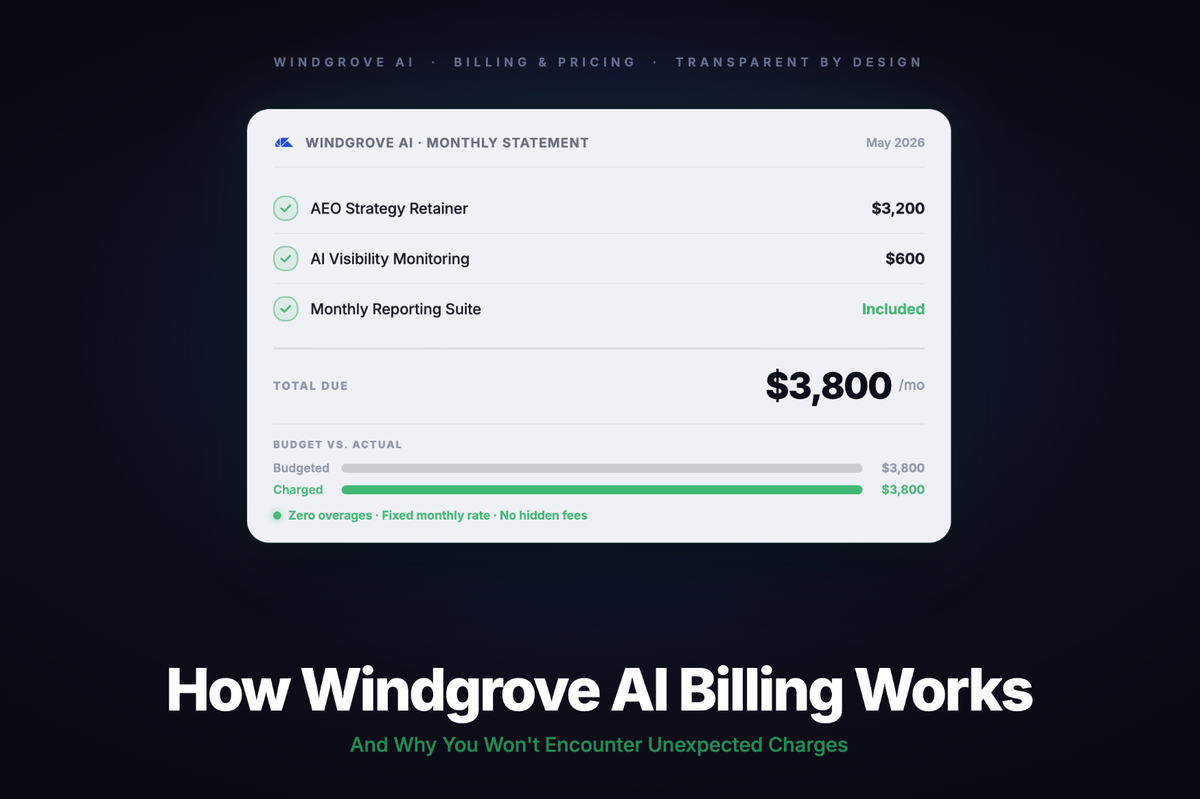
How Windgrove Billing Works at a Glance
Before you read further, here is the short version:
- Windgrove does not use hidden charges. Every fee is agreed upon before work begins.
- You will always know what you are paying for. Scope and pricing are defined upfront, in plain language.
- In limited cases, third-party websites or platforms charge separately for listings or placements. When that happens, Windgrove tells you in advance, explains exactly what the cost covers, and waits for your approval before spending a dollar.
- Nothing moves forward without your sign-off. If you decline an optional cost, it does not proceed.
That is the operating principle behind everything Windgrove does. The rest of this guide explains how it works in practice and what you can expect at every stage of the relationship.
Why Billing Clarity Matters More in AI Services
Buying AI services in 2026 is not like buying a fixed-price subscription. According to Zylo's 2026 SaaS Management Index, annual SaaS spend rose 8% while application counts stayed flat, meaning buyers are paying more without necessarily getting more. Nearly one-third of AI vendors now use hybrid pricing models that combine flat fees with usage-based or value-based charges. The result is billing that shifts mid-contract, often without clear warning.
That makes pricing transparency a real differentiator, not just a nice-to-have. When buyers evaluate an AI agency, they are not only asking "will this work?" They are asking "will I be in control of what I spend?"
The table below shows how two approaches compare:
What some AI services do | What Windgrove does |
|---|---|
Define scope loosely, adjust pricing later | Define scope and fees before work begins |
Bundle optional features into base billing | Separate core fees from optional third-party costs |
Notify clients after charges are incurred | Communicate all additional costs before acting |
Require clients to opt out of extra spend | Require explicit client approval before any extra spend |
Use vague line items on invoices | Invoice only for agreed, clearly described work |
The real issue: as the 2026 AI Trust Index found, trust in AI services is conditional. It rises when clients can verify what happened, see a clear audit trail, and know that a human is accountable for every decision. Windgrove builds that accountability into billing from day one.
How Windgrove Billing Works in Practice
The billing process is straightforward. Here is what it looks like from the moment you engage with Windgrove to the moment an invoice arrives.
- Scope and pricing are agreed before work begins. Before Windgrove starts any campaign or project, you receive a clear breakdown of what is included, what it costs, and what the deliverables are. There are no open-ended agreements that allow fees to expand without notice.
- Work is delivered against the agreed scope. Windgrove's team executes on what was defined. If something changes during the project, that conversation happens before any additional work is done, not after.
- Invoices reflect only what was agreed. When a bill arrives, every line item maps to something you approved. There are no surprise additions, no retroactive charges, and no fees for work you did not know was happening.
- Optional opportunities are presented separately. If Windgrove identifies an additional tactic or placement that could benefit your visibility, it is presented as a separate recommendation with its own cost and rationale. You decide whether to proceed.
- You can ask billing questions at any point. Windgrove welcomes questions before, during, or after a campaign. If anything on an invoice is unclear, the team will explain it. Clarity is not a courtesy here; it is how the relationship is designed to work.
The principle: Transparent reporting and built-in human oversight are what separate agencies that clients trust long-term from those that create friction at every renewal. Windgrove's billing process is built around that standard.
When Additional Costs Can Happen, and How Approval Works
Windgrove's own fees are fixed and agreed upfront. There is, however, one category of cost that can arise outside of that: third-party website listings and placements.
What this means in practice
Part of building AI visibility is getting your business cited and listed on external platforms, directories, and authoritative websites. Some of those platforms charge a fee for inclusion. Those fees are not Windgrove's revenue; they go directly to the third-party platform. But they do require additional budget beyond your core Windgrove engagement.
Important: Windgrove never incurs a third-party cost on your behalf without telling you first. If a listing or placement opportunity involves an external charge, here is exactly what happens:
- Windgrove identifies the opportunity and assesses whether it is worth pursuing for your visibility goals.
- You receive a clear explanation of what the platform is, what the fee covers, and why it is being recommended.
- The cost is presented to you before any commitment is made.
- You decide. If you approve, Windgrove proceeds. If you decline, the opportunity is set aside and no charge is incurred.
This process applies every single time. There is no situation in which Windgrove spends additional budget on your behalf without documented approval.
As Avalara's 2026 compliance outlook noted, accountability and auditable decision-making are fast becoming the baseline expectation in AI-era business relationships. Windgrove treats that standard not as a regulatory checkbox, but as the foundation of how client relationships should work.
What You Will Not Experience with Windgrove
Some billing concerns come up regularly when businesses evaluate AI agencies. Here is a direct answer to each one.
The concern | The reality at Windgrove |
|---|---|
"Will fees appear that I didn't agree to?" | No. Every charge maps to something you approved before work began. |
"Could a third-party cost be added without my knowledge?" | No. Any external platform fee is disclosed and approved before it is incurred. |
"Will I get a vague invoice I can't make sense of?" | No. Line items describe real, agreed deliverables in plain language. |
"What if I say no to an optional cost?" | Nothing happens. The spend does not proceed. |
"Can the scope quietly expand mid-project?" | No. Scope changes are discussed before they are acted on. |
Budget control stays with you. That is not a policy Windgrove follows reluctantly; it is the way the business was built. Clients who feel in control of their spend are the ones who stay, grow, and refer others. Transparency is not a trust signal. It is the operating model.
Questions to Ask Before Approving Any Agency Invoice
Whether you are working with Windgrove or evaluating any AI agency, these questions will tell you quickly whether billing is being handled properly.
Before you sign
- Is the scope of work written down and specific?
- Are the fees fixed, or can they change based on usage or platform decisions?
- Is there a clear distinction between the agency's fees and any third-party costs?
Before you approve additional spend
- Has the agency explained what the extra cost is for and why it is being recommended?
- Do you have the option to decline without affecting the core engagement?
- Is there a written record of your approval before the spend is made?
Before you sign off on an invoice
- Does every line item correspond to something you agreed to?
- Can the agency explain any item you do not recognise?
- Are there any charges you were not notified of in advance?
A trustworthy agency will not hesitate on any of these. Windgrove welcomes them. If you have billing questions before approving a campaign, reach out to the team directly before anything is confirmed.
FAQ: Windgrove AI Billing and Unexpected Charges
Does Windgrove have hidden charges? No. Every fee is agreed upon before work begins. There are no charges added after the fact without your knowledge or approval.
Can my invoice change without my approval? No. If anything outside the original scope is needed, Windgrove discusses it with you first. Work does not proceed, and charges are not incurred, until you have confirmed.
What happens if a third-party listing costs extra? Windgrove will explain the opportunity, the cost, and the reason for recommending it. You decide whether to proceed. If you say no, the listing is not pursued and no charge is incurred.
Can I ask billing questions before approving a campaign? Yes. Windgrove encourages this. Contact the team at contact@windgrove.ai with any questions about scope, fees, or third-party costs before giving your approval.
How does Windgrove keep billing clear from the start? By defining scope and pricing before work begins, separating core fees from optional third-party costs, and requiring explicit client approval before any additional spend is made. The process is designed so you are never surprised.