Why Your Business Isn't Showing Up in ChatGPT (And How to Fix It)

Open ChatGPT right now and type: "What's the best [your type of business] in [your city]?"
For most business owners, the result is the same: a confident, well-written answer that names competitors, cites sources, and makes recommendations — without mentioning you once. Not because you've done anything wrong. Because you've been optimizing for the wrong engine entirely.
The uncomfortable truth: According to research by Profound Strategy, 94.7% of brands receive zero mentions in ChatGPT recommendations. That's not a rounding error. That's nearly every business on the internet, invisible to a tool that millions of people now use to make buying decisions.
This isn't a Google ranking problem. It's a different problem, with different causes, and a different set of solutions. Here's what's actually going on — and where to start.
ChatGPT Doesn't Work Like Google
To understand why you're invisible, you first need to understand what ChatGPT is actually doing when it answers a question.
Google crawls your website and ranks it based on hundreds of signals: keywords, backlinks, page speed, user engagement. You show up when someone searches. ChatGPT does something fundamentally different. It synthesizes an answer from what it already knows, drawing on training data, real-time web sources (in the case of tools like Perplexity and ChatGPT with browsing enabled), and signals about which sources are credible and authoritative.
The result is that ranking on Google does not translate to appearing in ChatGPT. A brand can sit at position one on Google for a competitive keyword and be completely absent from AI-generated answers on the same topic.
The core distinction: Google ranks pages. AI engines cite sources they trust. These are two different credibility systems, and most businesses have only built for one of them.
How AI Engines Decide What to Cite
When an AI model constructs an answer, it is effectively asking: "What do I know about this, and which sources have established authority on the topic?" The signals it weighs include:
- Entity recognition: Is this brand a clearly defined, verifiable entity with consistent information across the web?
- Content structure: Is the content formatted in a way that makes it easy for a language model to extract a clean, citable answer?
- External validation: Is this brand mentioned, recommended, or linked to by sources the AI already trusts?
- Topical depth: Does this source demonstrate genuine expertise on the subject, or does it only mention it in passing?
None of these map neatly to traditional SEO tactics. A well-optimized title tag does nothing for AI visibility. A page stuffed with keywords may actually work against you if it lacks the directness and structure an AI needs to extract a useful answer.
The Four Reasons You're Not Showing Up
Most businesses fall into at least one of these gaps. Many fall into all four.
1. Your Content Answers the Wrong Questions
AI engines are built to respond to natural-language queries. When someone asks ChatGPT "What's the best accounting software for a small restaurant?", it looks for content that directly answers that kind of question. Not content that says "We offer industry-leading financial solutions for the hospitality sector."
Marketing language is invisible to AI. Specificity is what gets cited.
If your website is full of positioning statements and feature lists but lacks direct, plain-language answers to the questions your customers actually ask, you have a content structure problem. Not a content volume problem.
2. You Don't Exist as a Verified Entity
This is the gap most business owners don't expect. AI models build a picture of your brand from dozens of signals across the web: your Google Business Profile, your LinkedIn page, mentions in industry publications, your schema markup, directory listings, and more. When these signals are inconsistent, incomplete, or absent, the model can't confidently identify you as a real, trustworthy entity.
Think of it this way: if a journalist had never heard of your company and tried to verify it existed in 10 minutes using only public sources, what would they find? For most small businesses, the answer is: not much. AI models face the same challenge.
3. Your Site Has Technical Barriers AI Can't Get Past
Even if your content is excellent, it may be inaccessible to AI crawlers. Common blockers include:
Issue | What Happens |
|---|---|
JavaScript-rendered content | AI sees a blank page instead of your text |
Robots.txt blocking AI crawlers | Your site is explicitly telling AI not to read it |
Gated content (forms, paywalls) | The AI simply can't access what's behind the gate |
Missing structured data (schema) | The AI can read your content but can't interpret it efficiently |
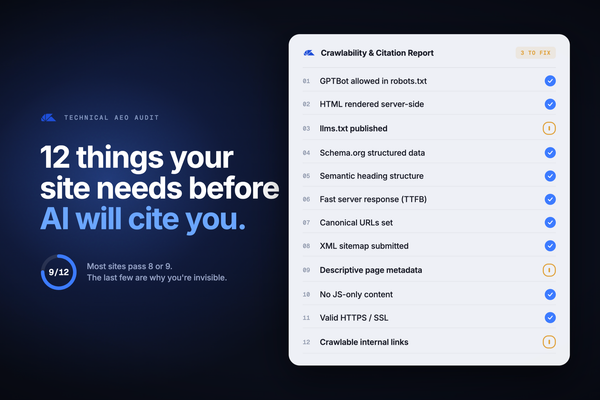
These are fixable, but they require a technical audit. Many businesses unknowingly block AI crawlers while allowing Google's bots through, assuming the two are equivalent. They are not.
4. No One Else Is Talking About You
Third-party validation is one of the strongest signals AI engines use to determine authority. If your brand is only mentioned on your own website, that's a weak signal. If it's mentioned in industry publications, cited in forum discussions, referenced in Reddit threads, and linked to from authoritative sources, that tells the AI your brand is real, established, and worth recommending.
This is the "digital footprint" problem. A business can be genuinely excellent and completely unknown to an AI because the web hasn't validated it yet.
Where to Start: The First Moves That Actually Matter
The good news is that AI visibility is still early enough that the bar isn't impossibly high. The brands dominating ChatGPT results in most industries got there not because they had massive budgets, but because they started earlier and built for the right signals.
Here's where to begin.
Run a Visibility Audit First
Before fixing anything, you need to know where you actually stand. Open ChatGPT, Perplexity, and Google's AI Overview, then search for the questions your customers are most likely to ask. Not your brand name. The actual questions.
- "What's the best [your service] for [your customer type]?"
- "How do I choose a [your category] provider?"
- "Who are the leading [your industry] companies in [your region]?"
Note which brands appear, which sources are cited, and whether you show up at all. This gives you a baseline and tells you exactly who you're competing against in the AI layer.
Restructure Your Content for Direct Answers
The most impactful change most businesses can make is rewriting their key pages to lead with direct, specific answers. Not preamble. Not brand story. The answer, in the first sentence.
A page that starts with "Founded in 2015, we've been helping businesses grow..." will not be cited. A page that starts with "[Business name] provides [specific service] for [specific customer type] in [location], specializing in [specific outcome]" gives an AI exactly what it needs to cite you confidently.
Structure your content like this:
- Direct answer to the question the page targets (1-2 sentences)
- Why it matters / context (1 short paragraph)
- Supporting evidence, examples, or data
This isn't just good for AI. It's better for human readers too.
Build Your Entity Footprint
Audit every place your brand should appear and make sure the information is consistent and complete:
- Google Business Profile: Claimed, verified, fully filled out with accurate categories and description
- LinkedIn company page: Active, with a clear description of what you do and who you serve
- Schema markup: At minimum, Organization schema on your homepage with your name, address, phone, and description
- Industry directories: Listed with consistent NAP (name, address, phone) data
- Third-party mentions: Press releases, guest articles, podcast appearances, or any content that puts your brand name in contexts AI can find and trust
Each of these signals, individually, is small. Together, they tell AI models that your business is a real, verifiable entity worth recommending.
Don't Ignore the Platforms AI Already Trusts
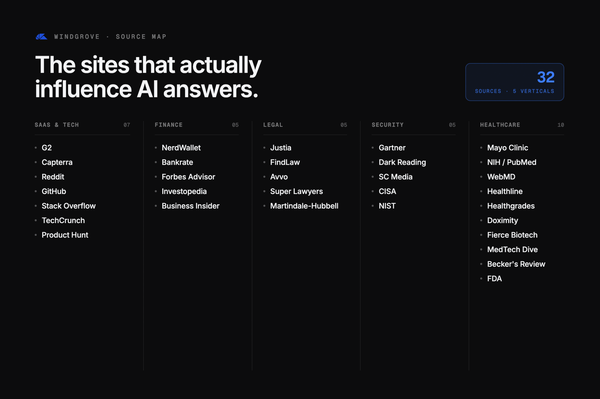
AI engines heavily weight content from platforms they already consider authoritative. YouTube, LinkedIn, Reddit, and industry publications are consistently cited in AI responses. If your brand has a presence on these platforms with content that addresses the questions your customers ask, you're building visibility in the places AI is already looking.
This is why a single well-written LinkedIn article or a YouTube video with a detailed description can sometimes drive more AI visibility than a dozen new blog posts on your own site.
The Window Is Still Open — But It Won't Be Forever
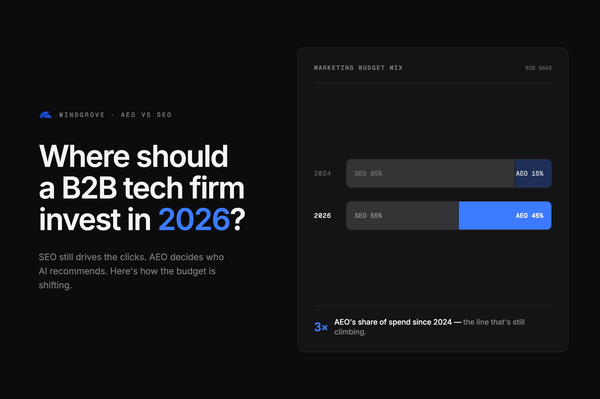
AI search is not a future trend to plan for. It's where your customers are finding answers right now. Gartner projects that 25% of traditional search traffic will shift to AI-generated answers by the end of 2026. The businesses that show up in those answers are being chosen as the default recommendation before a buyer ever visits a website.
The brands dominating ChatGPT results in most categories got there by acting early, not by outspending anyone. That window is still open in most industries, but it closes as more competitors wake up to the shift.
The first step is simply knowing where you stand. Run the audit. Search for your category in ChatGPT and see who's being recommended instead of you. That answer tells you everything about the gap you need to close.
AEO isn't about gaming an algorithm. It's about building the kind of digital presence that AI models recognize as authoritative, consistent, and worth recommending. The fundamentals — clear content, verified entity signals, technical accessibility, and third-party validation — are the same things that make a brand genuinely trustworthy. The difference is that now, getting those fundamentals right determines whether AI recommends you or your competitors.
What AI Visibility Looks Like in Practice
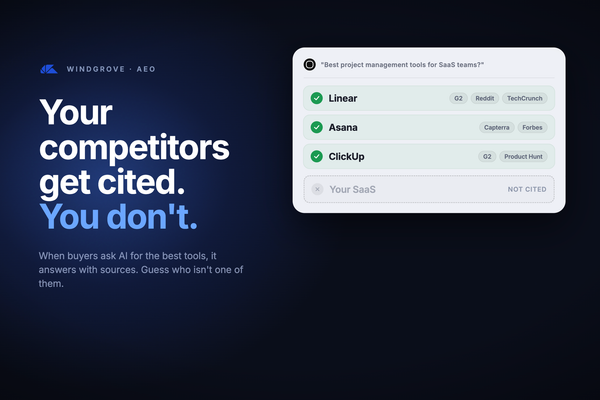
To make this concrete, consider what happens when a high-intent buyer searches for a service like yours in ChatGPT. The AI doesn't return a list of links. It returns a synthesized recommendation — confident, specific, and sourced. The brands it names are the ones that have done the work to be recognizable, verifiable, and citation-ready.
The screenshot below illustrates a typical ChatGPT response to a business-category query. Notice how it cites specific sources and names specific brands — not the ones with the biggest ad spend, but the ones with the clearest, most accessible, most authoritative presence.
This is the new front page of the internet. And unlike Google's first page, there are only a handful of spots — and no paid placements.